If you’re using a Fitbit device, chances are you’ve noticed a feature called VO2 Max. But how accurate are the VO2 Max measurements provided by Fitbit? As a fitness enthusiast or someone focused on improving cardiovascular fitness, you probably want to know whether these Fitbit estimates are reliable and if they match up to the gold standard for measuring VO2 Max.
In this blog, I’ll walk you through everything you need to know about Fitbit VO2 Max accuracy, how it compares to other devices like the Apple Watch and Garmin, and what you can do to improve your cardiorespiratory fitness using these fitness trackers.
Key Takeaways
-
Fitbit VO2 Max estimates provide a reliable way to track your cardiorespiratory fitness and aerobic capacity.
-
While Fitbit’s VO2 Max accuracy is not as precise as laboratory testing, it’s still highly effective for daily fitness tracking.
-
Regular HIIT and endurance training can significantly improve your VO2 Max and cardio fitness levels.
-
Fitbit devices provide an easy way to monitor your VO2 Max score and track improvements over time.
-
Consistency in exercise intensity and tracking progress through the Fitbit app can help you reach optimal cardiovascular fitness.
What is VO2 Max, and Why Does It Matter?
Before diving into the specifics of Fitbit VO2 Max accuracy, let’s take a moment to understand what VO2 Max is and why it’s so important for measuring <strong data-start="951" data-end=”976″>cardiovascular health.
VO2 Max, or maximal oxygen uptake, is the maximum amount of oxygen your body can use during intense physical activity. It’s considered a gold standard measurement for cardiorespiratory fitness and is often used by athletes to track their endurance capabilities. The higher your VO2 Max, the more oxygen your body can use, which translates to better endurance and fitness level.
For most people, improving VO2 Max is one of the best ways to boost overall aerobic fitness and reduce the risk of cardiovascular diseases. That’s why knowing how accurate your VO2 Max score is on your Fitbit is crucial for tracking your progress and adjusting your training.
How Does Fitbit Measure VO2 Max?
Fitbit devices, including the Fitbit Charge and Fitbit Charge 2, use heart rate data, exercise intensity, and activity level to estimate your VO2 Max. While this isn’t as precise as a direct measurement in a lab (which uses metabolic carts to measure oxygen consumption), it provides a fairly accurate estimate based on non-exercise prediction models and heart rate measurements.
Here’s a general breakdown of how Fitbit measures VO2 Max:
-
Heart Rate Monitoring: Fitbit devices continuously monitor your heart rate during exercise and at rest. This is crucial for determining how efficiently your heart is pumping blood, which is directly related to how well your body uses oxygen during physical activity.
-
Exercise Intensity: Fitbit uses the intensity of your exercise, including pace, speed, and exercise duration, to estimate your VO2 Max. Higher exercise intensity generally leads to higher oxygen uptake, which is a key factor in cardiorespiratory fitness.
-
Fitness Level: Fitbit also considers your fitness level in terms of activity level and past workouts. Over time, it learns from your performance and heart rate zones to provide more accurate VO2 Max estimates.
While these calculations are based on algorithms and non-exercise prediction models, Fitbit uses a combination of your personal data (such as age and gender) to provide you with a fairly accurate estimate of your VO2 Max score.
How Accurate is Fitbit’s VO2 Max Measurement?
The main question on most people’s minds when it comes to Fitbit VO2 Max accuracy is: How close are these estimates to the gold standard measurements done in a lab?
1. Fitbit vs. Laboratory Testing (Gold Standard)
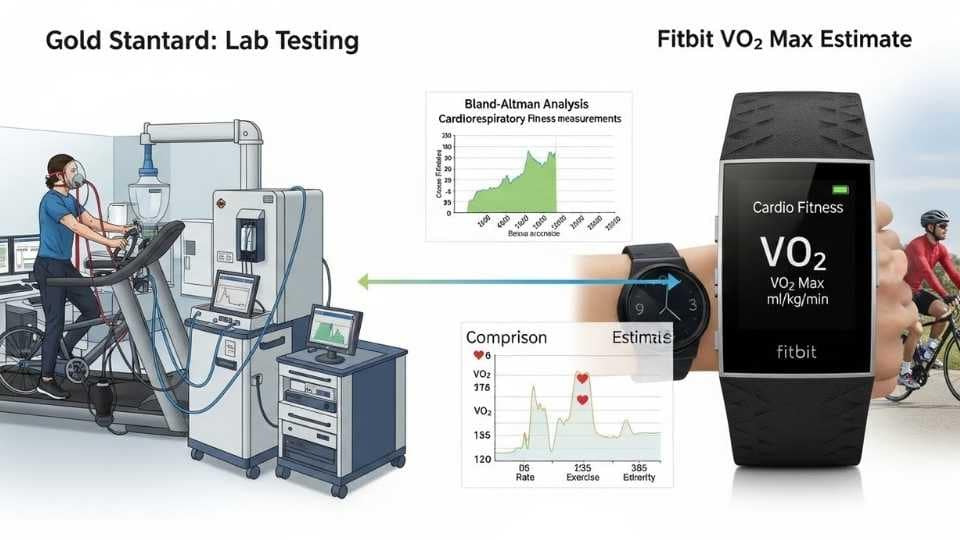
Laboratory testing for VO2 Max is the gold standard in cardiorespiratory fitness assessments. It involves using a metabolic cart in a clinical setting, typically with a treadmill or cycle ergometer, while you wear a mask to measure the oxygen you inhale and the carbon dioxide you exhale. This method provides an accurate VO2 Max reading by directly measuring your body’s oxygen consumption.
Compared to this, Fitbit devices rely on algorithms and estimates. While Fitbit can track your heart rate and exercise intensity accurately, it doesn’t directly measure oxygen consumption. Therefore, its VO2 Max estimates are not as precise as lab-based methods.
However, research has shown that Fitbit VO2 Max estimates are fairly close to the gold standard when tested in real-world scenarios. Studies using Bland-Altman analysis (a statistical method for comparing two measurement techniques) found that Fitbit’s VO2 Max estimates had a strong correlation with direct VO2 Max measurements—though they still tend to slightly underestimate VO2 Max in some cases.
2. Fitbit vs. Other Fitness Trackers (Apple Watch and Garmin)
When comparing Fitbit VO2 Max estimates to other popular fitness trackers like the Apple Watch and Garmin, the differences in accuracy are slight, but worth noting.
-
Apple Watch: The Apple Watch uses heart rate and GPS data to estimate VO2 Max and is often considered one of the more accurate wearable devices for tracking cardiovascular fitness. However, similar to Fitbit, it doesn’t measure oxygen directly but provides estimates that are fairly close to lab measurements.
-
Garmin Devices: Garmin fitness devices, such as the Garmin Forerunner series, use heart rate and aerobic exercise data to estimate VO2 Max. Garmin’s VO2 Max predictions are often regarded as highly reliable, especially for endurance athletes. However, like Fitbit, these are estimates and not direct measurements.
Can Fitbit Accurately Predict VO2 Max?
The ability of Fitbit Charge 2 and other Fitbit devices to predict VO2 Max accurately depends on several factors:
-
Exercise Intensity: If you’re engaging in low-intensity exercises like walking or light cycling, your Fitbit may have a harder time providing an accurate VO2 Max estimate. Higher-intensity workouts, especially aerobic exercises like running or cycling, provide better data for VO2 Max calculations.
-
Heart Rate Consistency: Fitbit uses heart rate as a primary data point to estimate VO2 Max. If your heart rate measurements are inconsistent or inaccurate due to external factors (e.g., wrist placement or sweat), it can affect the accuracy of the estimate.
-
Fitness Level: Fitbit also adjusts its estimates based on your overall fitness level. If you’re an experienced athlete with consistent high-intensity training, the Fitbit may provide a more accurate VO2 Max estimate.
Fitbit’s VO2 Max Scoring System:
Your VO2 Max score on Fitbit is categorized based on cardio fitness levels, from poor to excellent. These categories help you understand how your fitness level compares to others in your age group and gender.
How to Improve Your VO2 Max Using Fitbit
Once you understand your VO2 Max score on Fitbit, the next step is to improve your VO2 Max. Here are a few strategies to enhance your cardiorespiratory fitness:
1. High-Intensity Interval Training (HIIT)
HIIT is one of the most effective ways to boost your VO2 Max. This type of exercise involves alternating between short bursts of intense activity and rest periods. Studies have shown that HIIT can significantly improve your VO2 Max and cardiovascular fitness, which is why it’s highly recommended for anyone looking to increase their aerobic capacity.
2. Endurance Exercise
Engaging in endurance exercises like running, cycling, or swimming can also help improve VO2 Max. These activities challenge your cardiovascular system and gradually increase your oxygen uptake, which in turn raises your VO2 Max score.
3. Consistency and Tracking Progress
To improve your VO2 Max, consistency is key. Make use of Fitbit’s VO2 Max estimates to track your progress over time. Regular workouts, combined with tracking your fitness data on the Fitbit app, will help you see improvements in your cardiovascular fitness.
Summary
To wrap it up, Fitbit provides an excellent and convenient way to estimate your VO2 Max using heart rate and exercise intensity data. While it might not be as accurate as direct measurements in a lab, it offers a reliable and easily accessible method for tracking your cardiovascular fitness. Whether you use the Fitbit Charge, Fitbit Charge 2, or another Fitbit device, the key is consistency in tracking your workouts and monitoring changes in your fitness level over time.
By engaging in regular aerobic exercises, using your Fitbit device to track your VO2 Max, and adjusting your training intensity, you can effectively improve your VO2 Max and overall cardiorespiratory health.
FAQs
How accurate is Fitbit’s VO2 Max estimate?
Fitbit provides a reliable estimate of your VO2 Max, but it’s not as precise as a lab test. It’s a great tool for tracking cardio fitness over time, especially for non-athletes.
What is a good VO2 Max score on Fitbit?
A good VO2 Max score depends on your age and fitness level. Generally, higher scores (above 45 ml/kg/min) are considered excellent for endurance athletes.
Can Fitbit track VO2 Max while walking?
Fitbit estimates VO2 Max based on higher-intensity activities like running, cycling, or hiking. While walking may not provide an accurate VO2 Max estimate, it still contributes to overall cardiovascular health.
Can I improve my VO2 Max with Fitbit?
Yes, regular tracking and consistent endurance exercise will help improve your VO2 Max. Using Fitbit’s fitness trackers allows you to monitor your progress and adjust your workouts to boost cardiorespiratory fitness.