Key Takeaways
-
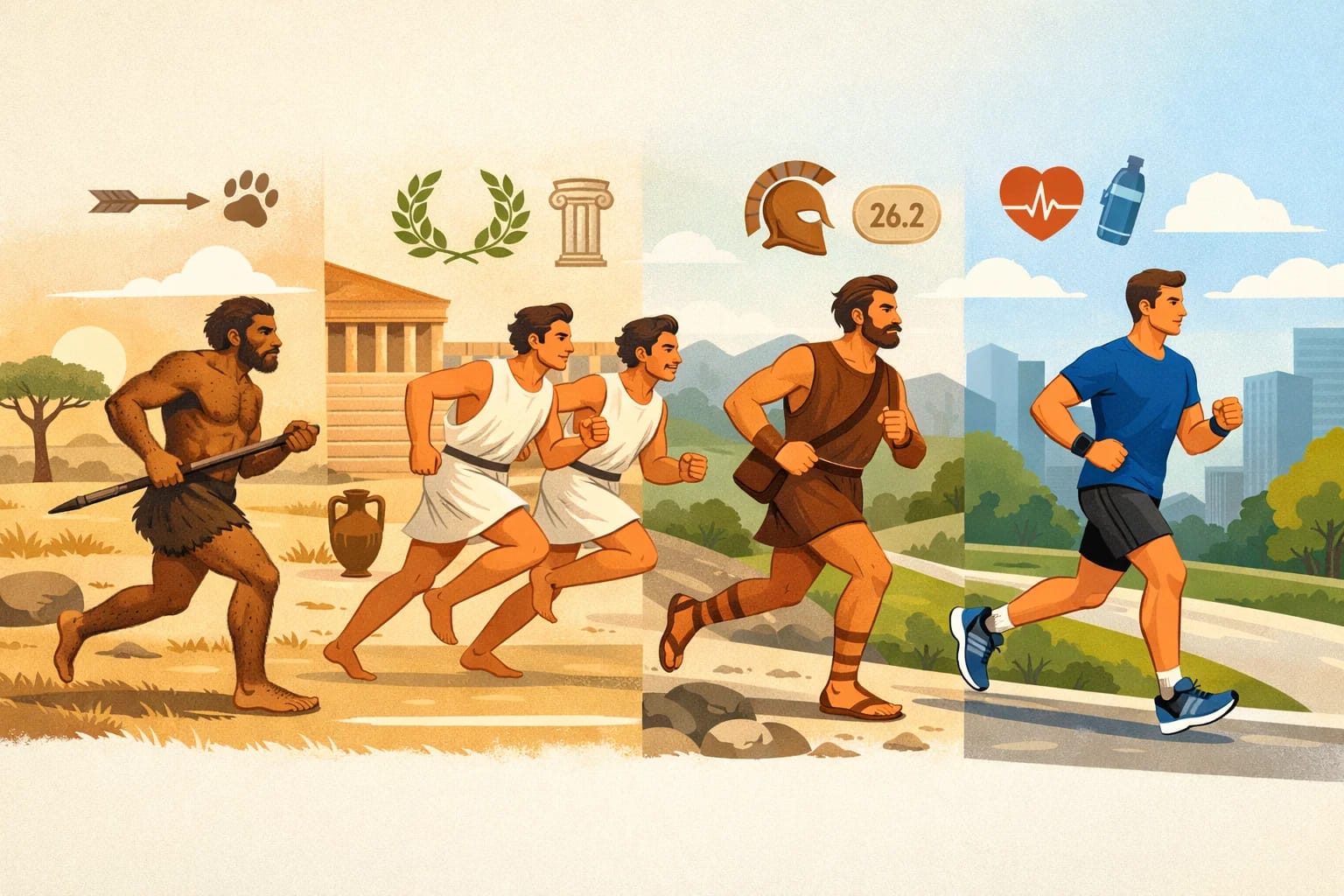
Running was never invented—humans have been running for millions of years as part of evolution, survival, and upright locomotion.
-
Early humans ran for survival, using endurance running for hunting, migration, and escape rather than for fitness or sport.
-
Running became a sport in ancient civilizations, especially in Ancient Greece and Ireland, long before modern rules existed.
-
The marathon as a sport is modern, inspired by events around 490 B.C.E. but formally established in the late 19th century with the Olympics.
-
Modern running evolved through jogging culture, biomechanics research, and global events, turning running into exercise, competition, and lifestyle.
Introduction
Running was not invented in a single year. Humans started running as soon as humans (and earlier hominins) could move upright on two legs, at least millions of years ago, and likely long before written history. Running later became a tool for survival, then a training method for war, then organized competition, then modern sport, exercise, and lifestyle.
This article explains the origins of running in human history, why early humans ran, how Ancient Greece and Ireland shaped running events, how the Marathon and Olympics formed modern racing, and how jogging and recreational running grew into a global phenomenon. It also covers modern running mechanics (footstrike to swing phase), good technique, health benefits (Cardiovascular, Metabolic, Mental), common injuries, race distances (including 10K and half marathon), and when the treadmill was invented.
When Was Running Invented?
Running was never “invented.” Running is a human movement skill that existed as soon as early humans and earlier hominins had bipedal locomotion. People later “invented” running as a sport by creating rules, races, and events.
The Earliest Running In Human History
Early human running predates writing, cities, and organized sport. The fossil record cannot show a single first human runner, but it does show a long Bipedalism evolutionary timeline and many anatomical running adaptations tied to upright locomotion beginning.
A practical answer for search intent is simple: humans have been running for millions of years.
Ancient humans and running
Ancient humans used running for 3 direct purposes:
-
Escape from predators and threats.
-
Pursuit during hunting and conflict.
-
Travel between water, shelter, and groups.
This is the core of running human history: early human running was running for survival, not sport.
Origins of Running
The origins of running sit inside human locomotion and evolution. Many researchers discuss Human cursorial evolution (adaptation for running), Homo erectus endurance, and long distance pursuit tied to Persistence hunting development.
People often connect this to the Savanna adaptation hypothesis, early hominin energetics, and sweating-based thermoregulation running. Universities like University College London (UCL) often publish and teach anthropology running and evolutionary biology running topics in this area, and many discussions link to NCBI (National Center for Biotechnology Information) papers for physiology and biomechanics.
Do Humans Have Better Endurance Than Animals?
Yes, humans can beat many animals in endurance running across heat and time, but not in short sprint speed. The advantage comes from a set of running physiological adaptations:
-
Efficient cooling through sweating
-
Stable head and trunk control
-
Elastic energy storage in tendons
-
Strong gluteal and hip stabilization for distance running
-
Social cooperation and pacing
This is why “Born to run theory” arguments exist. The claim is not that humans are the fastest, but that human endurance running can be unusually strong in the right conditions.
Running’s Role In Early Hunting and Survival
Running and hunting often appears as “Endurance hunting origins” or “persistence hunting.” The basic idea is Prehistoric chase hunting: keep steady pace, pressure prey, and use heat and fatigue as the limiter.
Running as survival also shows up in:
-
Hominid hunting strategies (group coordination)
-
Paleolithic running behavior (tracking, following, relocating)
-
Fossil evidence running arguments (body proportions and joint structure)
-
Adaptive bipedal locomotion benefits (hands free for tools and carrying)
Early Humans and Survival is where the “purpose of running” starts: move longer, move safer, and bring food back.
The Use Of Running In Military Training and Athletic Competitions
Military Training:
Military training used running to build 4 traits:
-
Cardiovascular capacity for repeated effort
-
Load carriage tolerance (boots, gear, weapons)
-
Group coordination (formation movement)
-
Mental resilience under fatigue
Modern military programs still use structured runs, intervals, and rucks. Sports medicine voices like S Robert Lathan, MD are often referenced in public discussions about overuse injuries and safe progressions, and organizations like NASM (National Academy of Sports Medicine) teach programming basics that overlap with military-style conditioning.
Athletic Competitions:
Athletic competitions turned running into measurable performance: distance, time, lanes, and rules. Ancient Civilizations and Running Events created the bridge from survival running to Running As A Sport.
Running As Part of Human History
Running is part of human identity because it is tied to migration, work, trade, messaging, and conflict. Before vehicles, running was a direct way to move information, warnings, and leadership decisions across terrain.
Modern writers and coaches such as Amanda Brooks and Katie McDonald often frame this as “why humans run” across eras: utility first, meaning later.
Running in Ancient Cultures: From Greece to Ireland
Ancient Greece formalized running as competition through events connected to the Olympics. Ireland is linked to early festival games and running contests, including The Tailteann Games.
Ancient Greece produced structured stadium racing, while Ireland’s tradition emphasizes community events and endurance challenges tied to cultural gatherings.
Running As A Symbol
Running can symbolize 5 common themes:
-
Freedom (movement without restraint)
-
Messenger duty (urgent delivery)
-
Discipline (training and restraint)
-
Escape and survival (staying alive)
-
Personal identity (habit, lifestyle, belonging)
Modern Running: A Global Phenomenon pushed this symbolism into charity runs, memorial runs, and social identity.
When Did People Start Using Running As A Symbol?
Running became a symbol when societies created stories and public meaning around athletic effort. That meaning became visible in:
-
Named races and ceremonial games
-
Military and civic duties tied to speed and endurance
-
Ritual events tied to seasonal festivals
Today this symbolic layer spreads through Youtube documentaries, LinkedIn posts from coaches, and app-based communities.
A Brief History of Running as a Sport
Fast forward to 490 B.C.E.
490 B.C.E. is central to marathon mythology because it is tied to the story of a messenger run connected to the Battle of Marathon. The story matters culturally, even though details are debated.
The Tailteann Games
The Tailteann Games are commonly discussed as an Irish tradition that included athletic contests. They appear in many histories as a cultural anchor for early sporting identity in Ireland.
The First Olympics
The First Olympics are linked to Ancient Greece and formal athletic structure.
First Olympics with Running
Running was one of the key events in early Olympic-style contests. It is one of the simplest events to standardize: define a distance and measure time or finishing order.
1896
1896 matters because the modern Olympic Games began, and modern race organization accelerated from that point.
The Birth of the Marathon: 1896 and Beyond
The Marathon became a modern standardized sport event in the late 1800s and early 1900s as rules, course measurement, and annual races expanded.
1897
1897 is often used in marathon timelines because organized annual marathon events began to appear and stabilize around that period.
1909
1909 appears in many running timelines as road racing and organized athletics broadened and public participation increased.
1972
1972 is commonly tied to modern running growth and wider participation across major events and training culture.
1984
1984 is a major marker for large-scale modern events and global visibility of running competitions.
2019
2019 is often used as a marker for modern performance, global participation, and the scale of modern marathons and mass events.
When Did People Start Running as a Sport?
People started running as a sport when societies created organized competitions with rules and public recognition. That began in ancient cultures and became globally standardized in the modern era through clubs, federations, and the Olympics.
When Was Running Invented As A Sport?
Running as a sport was “invented” when humans turned running into formal competition, starting in ancient events and becoming standardized in the modern Olympic era. Ancient Greece is the cleanest early example of formalized race events.
When Was the First Marathon?
The modern marathon was first established as a formal race in the late 19th century, linked to the modern Olympics and later standardized as a long-distance road race. The historical inspiration story points to 490 B.C.E., while the sport event is modern https://en.wikipedia.org/wiki/Marathon.
History of the Marathon
The Marathon sits at the center of modern long-distance racing. It connects myth, modern measurement, and mass participation.
History of the Marathon Outside Of the Olympics
Outside the Olympics, marathons became city events with annual schedules, sponsors, and large public entry lists. This is where “recreational running” and “running as lifestyle” expanded fast.
Boston Marathon: The World’s Oldest Annual Marathon
Running As A Profession
Running became a profession through:
-
Elite competition contracts and prize money
-
Coaching, programming, and certification pathways
-
Sports media and endorsements
-
Race directing and event operations
Modern coaches like Amber Sayer, MS, CPT, CNC and Chris Zibutis are examples of how the profession includes education, training plans, and community leadership across platforms like Linkedin and Youtube.
Rise in Recreational Running
Recreational running expanded when people began running for health, stress relief, and identity, not only for competition.
The Running Boom of the 1970s
The Running Boom of the 1970s is a widely used label for the period when jogging and road races became mainstream in many countries.
A history of jogging and running—the boom of the 1970s
Jogging became normal for non-athletes. Shoe companies, training books, and community races made entry easy. This period also pushed interest in The Evolution of Running Footwear, as people wanted comfort, cushioning, and injury prevention.
1962
1962 is often used in jogging timelines because modern jogging culture gained public structure through coaching methods and broader publication.
1967
1967 is commonly cited in jogging history because early mainstream jogging guidance became widely distributed and adopted.
1970
1970 appears in recreational running history because more large public races and city events began to form consistent annual patterns.
1982
1982 shows up in many running histories as mass participation races expanded and training culture became mainstream in more regions.
Running For Exercise
Running for exercise became common when modern health culture, urban life, and measurable training plans made running a repeatable habit for ordinary people. This is where structured plans, heart-rate focus, and distance targets became normal.
Apps and products now shape this space: Joggo, Brainway App, and Nordastro represent the current wave of training guidance, reminders, and planning tools, while brands like Rockay sit in the gear layer (socks, comfort, and everyday training support). Some runners also use tools labeled as AI, including OREATE AI, for plan generation and workout suggestions.
When was running invented as a type of exercise?
Running as a type of exercise was not invented in one year, but it became mainstream in the 20th century, especially during the jogging movement and the running boom of the 1970s. That is when everyday people started running on purpose for health.
When was the marathon invented?
The marathon was invented as a modern organized race in the late 19th century and became globally standardized through modern athletics and the Olympics. The inspiration story is ancient; the sport format is modern.
When was the 5k run invented?
The 5K run was created as a standardized modern race distance when metric track and road racing became common. It became widely popular as a community race format because it is short enough for new runners and structured enough for competitive timing.
When was the 10k run invented?
The 10K run was created as a standardized modern race distance through metric-based track and road racing. It grew fast because it fits both performance runners and recreational runners aiming for a clear distance goal.
Running in the third millennium
Running in the third millennium is shaped by 5 forces:
-
GPS watches and phone tracking
-
App coaching and online communities
-
Global travel races and destination events
-
Science-driven training content via NCBI and university research
-
Identity-driven running culture across social platforms
Modern dates show up in race calendars and community events. People reference dates like Feb 26, 2024, April 14th, and 19th May because running culture now lives on organized schedules and public race weekends.
Running in modern times
Running in modern times is a global habit with local communities. It includes track, road, trail, treadmill, and cross-training. It also includes high-performance coaching pathways like UESCA (United Endurance Sports Coaching Academy) for endurance athletes.
History of cross-country running
Cross-country running formed as organized racing across natural terrain. It emphasizes uneven ground, pacing, weather, and team scoring in many formats.
History of speed running
Speed running in running culture refers to sprint performance and short-distance track events. Sprinting rewards acceleration mechanics, stiffness, and high force output, not endurance.
The first marathon
The first marathon as a modern sport event belongs to the modern era of organized athletics. The ancient story is tied to 490 B.C.E., while the race format belongs to modern standardization.
History of jogging
Jogging moved running from “athlete only” to “everyone can do this.” It became a public health habit, a stress tool, and a social identity. It also created demand for footwear design, injury prevention education, and coaching credentials like NASM.
Did we evolve to run?
Yes, humans evolved traits that support endurance running. The list usually includes:
-
Thermoregulation running through sweating
-
Elastic tendons for energy return
-
Pelvic and trunk stability for repeatable stride
-
Long legs and efficient gait mechanics
-
Brain and cognition support for pacing and navigation under fatigue
This connects to early hominid adaptations, Australopithecus running capacity discussions, and Homo erectus endurance arguments. The exact start point is debated, but the evolutionary running advantages are not controversial: humans are built for distance movement more than for pure sprint speed.
Why Do People Run?
People run for 6 clear reasons:
-
Improve Cardiovascular health
-
Improve Metabolic health
-
Support Mental health
-
Compete in Running As A Sport
-
Belong to a community
-
Mark identity and meaning
Why People Start Running: Then and Now
Then: survival, hunting strategies, escape, and duty.
Now: exercise, stress control, measurable goals, and personal identity.
The motive shifted, but the movement stayed the same.
Running as a Symbol and Lifestyle
Running as lifestyle includes routine, gear choices, training blocks, and community identity. It also includes storytelling and memes, which can distort history while still shaping culture.
So What Does the History of Running Teach Us?
The history of running teaches 4 direct lessons:
-
Running is older than civilization.
-
Running started as function, then became sport and meaning.
-
Running’s benefits are broad: Cardiovascular, Metabolic, Mental.
-
Running’s risks are predictable and manageable with technique and progression.
Myths and Memes: The Tale of Thomas Running
Thomas Running is a meme-style character used online as a joke “inventor” of running. The meme often includes fake timelines and fake dates, sometimes even odd claims like “running invented 1748.”
Did Thomas Running invent running?
No, Thomas Running did not invent running. Humans ran long before names, cities, and written records.
If Thomas Running invented running..
If Thomas Running invented running, there would be a single year, a patent, and a clear origin record. Running has none of that. Running exists because of evolution of running and the human body’s locomotion design.
A real look at the history of running
A real look stays grounded:
-
Running predates written history
-
Ancient cultures formalized competitions
-
Modern sport standardized distances and rules
-
Recreational running expanded through jogging culture
-
Modern running became global through events, media, and technology
A timeline of the history of running
-
Prehistory: early human running used for survival and hunting
-
Ancient era: organized running events in Ancient Greece and other cultures
-
490 B.C.E.: marathon story enters cultural memory
-
1896: modern Olympic era accelerates standardization
-
1970s: mass jogging and recreational running boom
-
2019: modern running is fully global, data-driven, and mass-participation
A Timeline of How Modern Running Evolved
Modern running evolved through 6 layers:
-
Organized rules and distances
-
Clubs and national federations
-
Mass races and city marathons
-
Training science and coaching education
-
Apps, wearables, and online communities
Description
Running is a gait cycle with repeatable phases. The phases below explain how the body moves and why technique matters.
Footstrike
Footstrike is the moment the foot contacts the ground. Footstrike can be rearfoot, midfoot, or forefoot depending on speed, terrain, shoes, and individual mechanics.
Midstance
Midstance is the support phase where the body passes over the stance leg. Stability at the hip and trunk matters here.
Propulsion phase
Propulsion phase is the push-off. The ankle, calf, and hip extension contribute to forward motion.
Swing phase
Swing phase is when the leg recovers forward. Efficient swing reduces wasted motion and helps stride rhythm.
Upper extremity function
Upper extremity function controls balance and rhythm. Arm swing helps stabilize rotation and supports pace maintenance.
Footstrike debate
Footstrike debate often gets oversimplified. The practical goal is stable alignment, controlled impact, and a stride that matches speed and anatomy.
Stride length, hip and knee function
Stride length should match hip and knee function. Overstriding raises braking forces. Efficient stride supports endurance and lowers injury risk.
Good technique
Good technique is not one perfect style. Good technique is a set of repeatable basics that reduce wasted motion.
Upright posture and slight forward lean
Upright posture with a slight forward lean supports balance and forward momentum without collapsing at the waist.
Stride rate and types
Stride rate is commonly tracked as cadence. A steady, comfortable cadence often helps reduce overstriding and impact spikes.
Left and right balance
Left and right balance matters for injury prevention. Persistent asymmetry often shows up as repeated soreness in one side.
Health benefits
Running has 3 main health benefit categories.
Cardiovascular
Cardiovascular benefits include improved aerobic capacity, lower resting heart rate, and better circulation.
Metabolic
Metabolic benefits include improved insulin sensitivity, better weight management support, and improved energy regulation.
Mental
Mental benefits include stress reduction, mood support, and improved sleep quality for many runners.
Injuries
Running injuries are common when volume rises too fast, sleep is poor, or technique breaks down under fatigue.
High impact
High impact load builds fast with poor progression. A simple rule helps: increase weekly volume slowly and keep easy runs easy.
Chafing
Chafing is friction plus moisture. Clothing fit, fabric choice, and skin protection solve most cases quickly.
Iliotibial band syndrome
Iliotibial band syndrome often relates to load management, hip strength, and repeated downhill or cambered running. Strength work and smarter volume usually fix the pattern.
Events
Running events cover speed limits, distance limits, and many race formats.
Limits of speed
Speed has human limits because force production, stiffness, and coordination cap sprinting ability.
Speed over increasing distance based on world record times
Speed drops as distance increases. Sprint speed is not sustainable over 10K, half marathon, or Marathon distances because energy systems shift and fatigue rises.
Types
There are 6 common event types:
-
Track sprint
-
Track middle distance
-
Track long distance
-
Road racing
-
Cross-country running
-
Trail and ultra formats
Distances
Running distances often cluster into 3 groups.
Sprints
Sprints include very short events where acceleration and max speed dominate.
Middle distance
Middle distance includes events where speed endurance matters most.
Long distance
Long distance includes road and track distances like 5K, 10K, half marathon, and Marathon formats.
When was the treadmill invented?
The treadmill was invented as a machine long after humans were already running. A treadmill is equipment history, not the origin running story.
What is the treadmill?
A treadmill is a moving belt or rotating surface that allows walking or running in place while controlling speed and incline.
When was the treadmill invented?
Early treadmills were built for labor and punishment before they became exercise machines. Modern home fitness treadmills are a late 20th-century consumer product, built for training convenience and weather-free running.
The internet sometimes throws around random dates, including 1748, but that type of claim does not match the real point: humans did not start running because a treadmill existed.
The Advantages Of Using Modern Treadmills For Running
Modern treadmills offer 5 practical advantages:
-
Stable pacing control
-
Weather-free training
-
Incline control for hill simulation
-
Reduced route planning friction
-
Safer conditions for some runners (lighting, traffic)
Summary
Running was not invented. Humans have been running for millions of years as part of human evolution, early hunting survival, and daily locomotion. Ancient cultures turned running into formal events, modern sport standardized races like the Marathon, and the jogging movement made running a mainstream exercise habit. Modern running now includes biomechanics awareness, training science, global events, and digital coaching ecosystems across apps, gear, and communities.
If a single sentence must answer the main query: Running was never invented by humans; humans started running as soon as humans could move on two legs, and organized running as a sport began in ancient competitions and was standardized globally in the modern Olympic era.
When Was Running Invented by Humans?
Understanding when was running invented by humans enhances our connection to the fundamental aspects of movement.
Delving into when was running invented by humans offers insights into our evolutionary advantages.
Ultimately, examining when was running invented by humans invites us to appreciate our physical capabilities.
When was running invented by humans is a pivotal question that connects us to our ancestral past and the evolution of human mobility.
Exploring when was running invented by humans allows us to connect with our heritage and the importance of movement in our lives.
As we consider the question of when was running invented by humans, we recognize its significance in understanding our evolution and capabilities.
When was running invented by humans is not just a question of history; it’s a celebration of human potential and achievement.
When was running invented by humans is not just a question of history; it’s a celebration of human potential and achievement.
As we consider the question of when was running invented by humans, we recognize its significance in understanding our evolution and capabilities.
Exploring when was running invented by humans allows us to connect with our heritage and the importance of movement in our lives.
When delving into the topic of when was running invented by humans, we reflect on our shared journey and resilience as a species.
Understanding when was running invented by humans ultimately enriches our appreciation of physical culture and human history.
Running, as we explore when was running invented by humans, embodies our adaptability and the spirit of perseverance.
Finally, the inquiry into when was running invented by humans encapsulates the essence of being human: our capacity for movement and growth.
Delving deeper into when was running invented by humans reveals the layers of our shared legacy and cultural history.
When was running invented by humans is a query that invites collaboration between different fields of study, enhancing our collective knowledge.
In analyzing when was running invented by humans, we gain insights into human resilience and endurance.
There’s much to learn from when was running invented by humans, particularly regarding adaptation and survival strategies.
The exploration of when was running invented by humans not only engages historians but also enriches athletic training philosophies.
Ultimately, the question of when was running invented by humans leads us to reflect on our identity as a species.
The ongoing inquiry into when was running invented by humans reflects our desire to connect with our past and understand our origins.
The discussion surrounding when was running invented by humans continues to evolve, mirroring advancements in our understanding of human history.
When was running invented by humans is a crucial inquiry for understanding the depth of our physical culture’s history.
As we ponder on when was running invented by humans, we also recognize its enduring legacy in our culture today.
Therefore, when was running invented by humans is more than a historical query; it’s a reflection of our evolutionary success.
Understanding when was running invented by humans can enlighten current practices and future innovations in running.
A pivotal question remains: when was running invented by humans, and how does that shape our understanding of human capabilities?
The exploration of when was running invented by humans encourages a broader discussion on human athleticism through the ages.
Scholarly research on when was running invented by humans continues to emerge, reflecting its ongoing relevance in anthropology.
As we delve into our past, we must consider when was running invented by humans as a vital part of our evolutionary journey.
In historical discussions, when was running invented by humans serves as a cornerstone for evaluating human development milestones.
Unpacking the topic of when was running invented by humans provides insight into our ancestors’ adaptive strategies in their environments.
The narrative of when was running invented by humans intertwines with cultural and societal evolution throughout history.
Reflecting on when was running invented by humans enhances our understanding of physical activity’s historical significance.
Ultimately, the inquiry into when was running invented by humans opens avenues for further exploration in sports science.
Numerous studies examine when was running invented by humans and its implications for human health and endurance.
Many experts are intrigued by when was running invented by humans and how it has influenced modern fitness culture.
The question of when was running invented by humans is essential for understanding the role of running in ancient societies.
In our examination of human activities, we often reflect on when was running invented by humans as a pivotal moment in our evolution.
When considering the origins, we cannot ignore the question of when was running invented by humans in the context of athletic development.
Moreover, the debate around when was running invented by humans continues to inspire research and discussion among anthropologists.
In the context of history, the question of when was running invented by humans is significant for understanding our ancestors’ lifestyle.
Understanding when was running invented by humans helps to appreciate the evolution of this fundamental human activity.