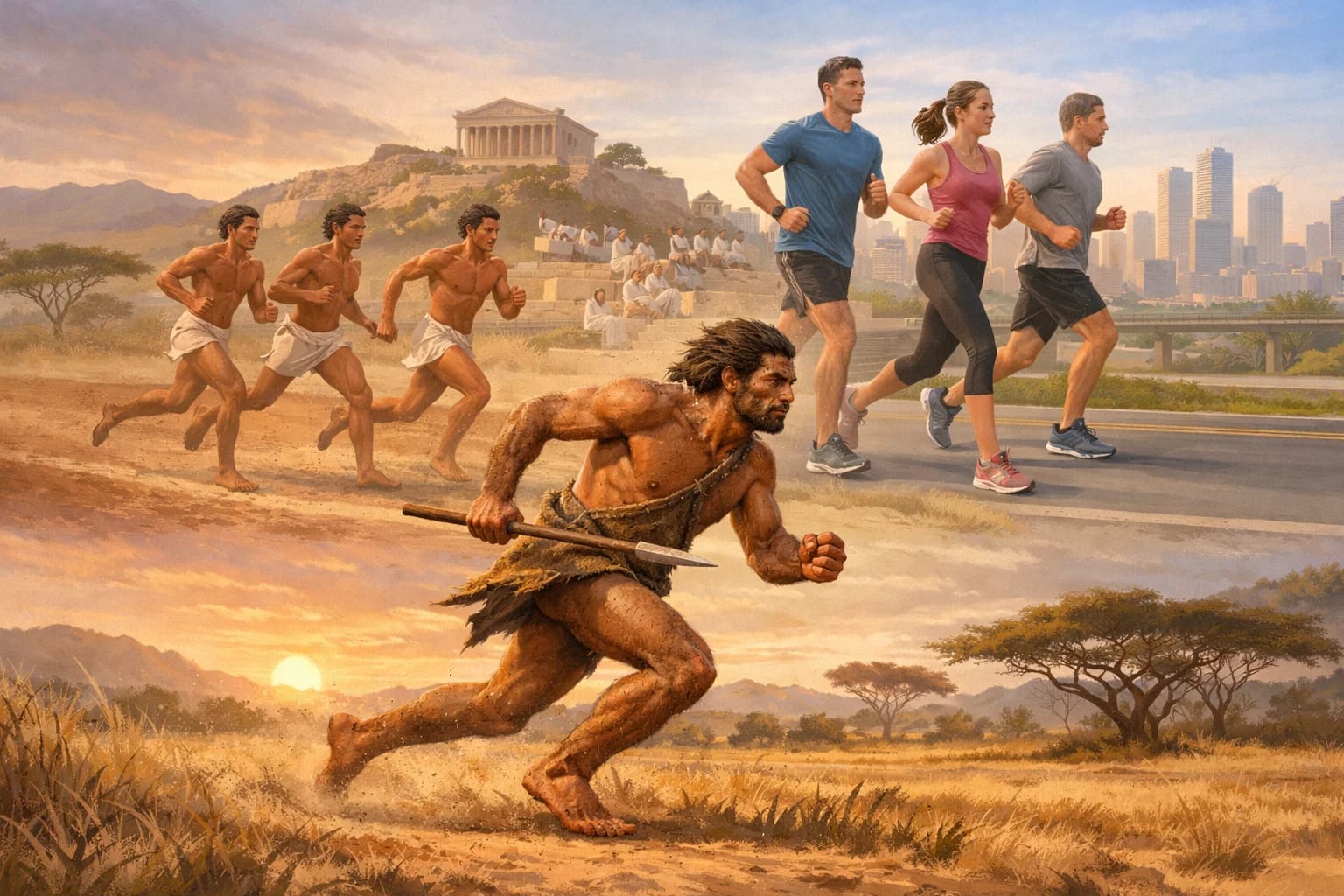
When Was Running Invented? The Complete History of the Marathon and Human Endurance
When was running invented? Discover the true history of running, the origins of the marathon, the first Olympic marathon, and how marathon racing began.
Key Takeaways:
- Running was not invented — it evolved as a natural human survival ability millions of years ago.
- The marathon’s historical roots trace back to 490 BCE, but the modern marathon began in 1896.
- The Boston Marathon (1897) is the world’s oldest annual marathon.
- Running became widely popular in the U.S. during the 1970s running boom.
- Many online claims about specific invention years (1747, 1748, 1900, 1938) are myths.
When Was Running Invented?
If you’re searching “When was running invented?”, here’s the clear answer:
Running was never invented.
It is a natural human ability that developed through evolution.
Unlike the wheel or the phone, running did not have a single inventor or year of creation. Humans evolved the ability to run long distances roughly 2 million years ago, long before recorded history.
However, the marathon as a race does have a starting point — and that story begins in ancient Greece.
Let’s break it down.
The Evolution of Running: Before the Marathon Existed
6–7 Million Years Ago: The Origins of Walking
Early human ancestors began walking upright. This shift to bipedal movement eventually made endurance running possible.
~2 Million Years Ago: Endurance Running Develops
Anthropologists believe early Homo species developed:
- Efficient stride mechanics
- Sweat-based cooling systems
- Strong lower limbs
- Exceptional long-distance stamina
This gave humans a rare advantage: endurance over speed.
Humans are not the fastest sprinters — but we are among the best endurance movers on Earth.
This endurance ability laid the biological foundation for what would eventually become marathon running.
The History of the Marathon: Where It Really Begins
Now we shift from evolution to marathon history.
490 BCE: The Legendary First Marathon
The marathon story traces back to 490 BCE, after the Battle of Marathon in Greece.
According to later historical tradition, a messenger ran from the battlefield of Marathon to Athens — roughly 25 miles — to deliver news of victory.
While historians debate details, this legend inspired the modern marathon race.
Important note:
The race we know today did not exist in 490 BCE. The standardized marathon came much later.
776 BC: The Birth of Competitive Running
The earliest recorded organized footrace dates to 776 BC, during the ancient Olympic Games in Greece.
These early races were:
- Short-distance sprint events
- Held in stadiums
- Symbols of honor and civic pride
This marks one of the earliest documented moments in the history of running as a sport.
1896: The First Modern Olympic Marathon
If you’re asking:
When did the marathon start officially?
The answer is 1896.
During the first modern Olympic Games in Athens, organizers introduced a marathon race inspired by the 490 BCE legend.
This event marked:
- The first official modern marathon
- The beginning of standardized long-distance racing
- The global spread of marathon competition
This is the true birth of the marathon as we know it.
1897: The Boston Marathon Begins
One year later, in 1897, the Boston Marathon was established.
It is widely recognized as:
- The world’s oldest annual marathon
- A foundational event in American distance running history
- A major contributor to marathon culture worldwide
The Boston Marathon helped transform the marathon from an Olympic novelty into a permanent endurance tradition.
Early Marathon Chaos: The First Marathon “Disasters”
Early marathons were not smooth events.
Runners faced:
- Dusty, unpaved roads
- Limited hydration knowledge
- Poor medical understanding
- Extreme heat conditions
Modern race safety standards did not exist yet.
The marathon evolved through trial, error, and resilience — shaping the safer, organized events we see today.
When Did Running Become Popular in the United States?
Although marathon racing began in the late 1800s, mass recreational running didn’t surge until much later.
The 1960s–1970s Running Boom
Running became widely popular in the U.S. during the 1970s due to:
- Public health awareness
- Growth of road races
- Increased media coverage of marathons
- The fitness movement
This era transformed running from a niche competitive sport into a mainstream fitness habit.
1984: A Turning Point in Marathon History
The 1984 Los Angeles Olympics introduced the first Women’s Olympic Marathon.
This was a landmark moment because it:
- Validated women’s long-distance endurance
- Increased visibility for female marathon runners
- Changed the global perception of who could compete
The marathon became more inclusive — and participation numbers grew rapidly afterward.
2019 and the Modern Marathon Era
By 2019, marathon culture had evolved dramatically:
- Advanced carbon-plated running shoes
- GPS watches and data tracking
- Training apps and online coaching
- Global marathon tourism
The marathon is no longer just a race — it’s a global endurance movement.
Internet Myths: Who “Invented” Running?
You may see searches like:
- Who invented running in 1748?
- When was running invented 1747?
- When was running invented 1900?
- Thomas Running invented running?
These are internet myths or memes.
There is no historical evidence of a person inventing running in any of those years.
Running existed long before written history. What changed in the 1900s was organization, race structure, and global competition.
Jogging — as a casual fitness activity — became popular in the United States during the 1960s.
Unlike marathon racing, jogging was promoted for:
- Heart health
- Weight control
- Stress relief
- Longevity
Jogging pace typically means a comfortable speed where you can hold a conversation — often 11–15 minutes per mile for beginners.
Is Running a Sport?
Yes — when organized, timed, and competitive.
But running is also:
- Exercise
- Transportation
- Therapy
- Community
- Personal challenge
The marathon represents the competitive peak of human endurance — but running itself remains deeply human and universal.
The Complete Timeline of Marathon History
Here is a simplified marathon-focused timeline:
- ~2 million years ago — Humans develop endurance running ability
- 776 BC — First recorded Olympic footrace
- 490 BCE — Marathon legend originates
- 1896 — First modern Olympic marathon
- 1897 — Boston Marathon begins
- 1970s — U.S. running boom
- 1984 — Women’s Olympic marathon debut
- Modern era — Technology reshapes marathon racing
Final Answer: When Was Running Invented?
Running was never invented.
It evolved over millions of years as a survival mechanism.
The marathon, however, officially began in 1896, inspired by a 490 BCE legend.
From ancient Greece to modern Boston and beyond, marathon history represents one of humanity’s greatest endurance traditions.
FAQs (SEO-Optimized for Featured Snippets)
When was running invented by humans?
Running was not invented. Humans developed endurance running ability approximately 2 million years ago through evolution.
When did the marathon start?
The modern marathon began in 1896 at the first modern Olympic Games in Athens.
What was the first marathon ever?
The first official modern marathon was held in 1896. It was inspired by the 490 BCE legend of a messenger running from Marathon to Athens.
What is the oldest marathon in the world?
The Boston Marathon, established in 1897, is the world’s oldest annual marathon.
When did running become popular in the United States?
Running became widely popular during the 1970s running boom, driven by public health awareness and the growth of road races.
FAQs
When was running invented by humans?
Running wasn’t invented. Humans developed the ability over a long period. Endurance running is often tied to early humans around ~2 million years ago, while sport racing came much later.
When did people start running?
People likely started running as soon as they could move quickly on two legs. Survival needs like hunting, escaping danger, and traveling helped make running useful.
When did running become popular in the United States?
Running became widely popular as a hobby and fitness habit in the U.S. during the 1960s and especially the 1970s, with more road races and public fitness culture.
When was jogging invented, and what is jogging pace?
Jogging as a planned fitness habit became popular in the U.S. in the 1960s. Jogging pace is a comfortable pace where you can breathe steadily and talk in short sentences. Many people fall around 11–15 minutes per mile.
Who invented running 1748?
No one invented running in 1748. This phrase shows up online because of memes, jokes, and confusion. Running existed long before written history.