Zone 2 Training for Runners Over 50: 7 Powerful Ways to Build Endurance and Burn Fat

Zone 2 Training for Runners Over 50 is one of the most effective—and often misunderstood—ways to build endurance, improve energy, and stay consistent without burnout.
If your runs have started to feel harder, your recovery takes longer, or your energy feels unpredictable, the problem may not be your effort.
It may be your intensity.
This is where a different approach becomes essential.
What Zone 2 Actually Means
Zone 2 refers to a level of effort where your body is working aerobically at a sustainable pace.
It’s not slow because you are weak.
It’s slow because it is efficient.
At this level:
- You can hold a conversation
- Your breathing is controlled
- You feel like you could continue for a long time
This is the foundation of endurance training.
Many runners avoid it because it feels “too easy.”
But that perception is exactly why it works.
Understanding Heart Rate Zones
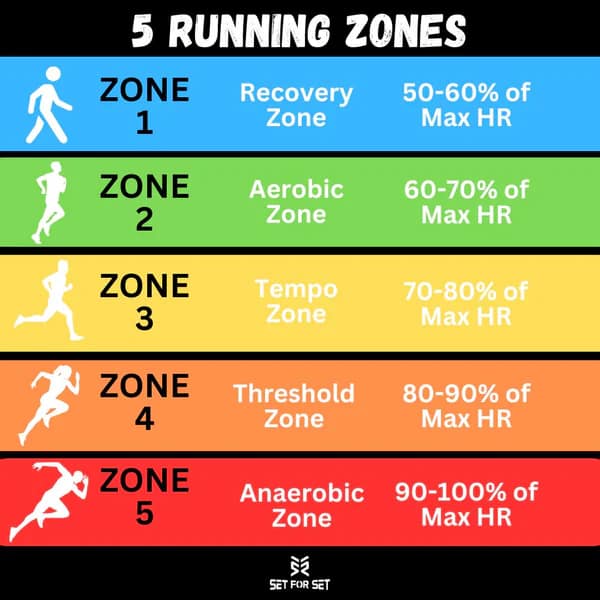
Your body operates across different intensity levels, commonly divided into five heart rate zones.
These zones are based on your maximum heart rate.
A simple estimation:
👉 220 – your age = estimated max heart rate
From there:
- Zone 1: Very light (50–60%)
- Zone 2: Easy aerobic (60–70%)
- Zone 3: Moderate (70–80%)
- Zone 4: Hard (80–90%)
- Zone 5: Maximum effort (90–100%)
Zone 2 sits in that 60–70% range.
For a 50-year-old:
- Estimated max HR = 170
- Zone 2 ≈ 102–119 bpm
This is where your body becomes more efficient at using oxygen and fuel.
👉 For more detail on heart rate training, see:
https://www.heart.org/en/healthy-living/fitness/fitness-basics/target-heart-rates
Why This Approach Matters More After 40
As you move into midlife, several physiological shifts occur:
1. Slower Recovery
Your body takes longer to repair muscle and restore energy.
High-intensity training creates more stress than your body can easily handle.
2. Increased Stress Sensitivity
Life stress, hormonal changes, and sleep variability all impact how your body responds to training.
Too much intensity adds to that load.
3. Reduced Aerobic Efficiency
Without proper training, your aerobic base declines.
This leads to:
- faster fatigue
- higher heart rate at lower effort
- less endurance
4. Hormonal Changes
Estrogen plays a role in:
- muscle recovery
- metabolism
- inflammation
As levels fluctuate during perimenopause and menopause, your training needs shift.
👉 Read more:
https://www.ncbi.nlm.nih.gov/pmc/articles/PMC3940206/
This is why many runners find that what worked at 30 no longer works at 50.
The solution isn’t to push harder.
It’s to train differently.
Fat Metabolism and Endurance
One of the biggest benefits of Zone 2 training is its impact on fat metabolism.
At lower intensities, your body uses fat as a primary fuel source.
At higher intensities, it relies more on carbohydrates.
- improves your ability to burn fat
- preserves glycogen (energy stores)
- increases endurance capacity
This is especially important in midlife, where metabolic flexibility becomes less efficient.
The Hormonal Impact
Training intensity directly affects your hormonal system.
High-intensity training increases:
- cortisol (stress hormone)
- inflammation
- fatigue
Zone 2 training, on the other hand:
- supports hormonal balance
- reduces stress load
- improves recovery
For women over 50, this shift is critical.
Your body is no longer optimized for constant stress.
It responds better to consistency and balance.
How It Should Feel
Instead of focusing only on numbers, use effort as your guide.
A proper Zone 2 run should feel:
- comfortable
- controlled
- sustainable
You should be able to speak in full sentences.
If you feel breathless, you’re going too fast.
This is where many runners struggle.
Slowing down feels counterintuitive.
But this is where real progress begins.
Common Mistakes
Running Too Fast
Most runners stay in Zone 3—too hard for recovery, too easy for performance gains.
Ignoring Recovery
Even with lower intensity, recovery still matters.
Chasing Pace
Pace is not the goal here.
Efficiency is.
Not Trusting the Process
This approach requires patience.
But the results are long-term.
Sample Training Week
Here’s a simple structure designed for midlife runners:
Monday
Walk or rest
Focus on recovery
Tuesday
Easy run (Zone 2)
20–30 minutes
Wednesday
Rest or light movement
Thursday
Easy run (Zone 2)
20–30 minutes
Friday
Walk or recovery day
Saturday
Long run (Zone 2)
30–45 minutes
Sunday
Rest
This structure emphasizes:
- consistency
- recovery
- sustainability
How to Start
If you’re new to this approach:
Step 1
Slow down more than you think
Step 2
Use a heart rate monitor if possible
Step 3
Focus on feel, not pace
Step 4
Stay consistent for 3–4 weeks
What to Expect
In the beginning:
- runs may feel unusually slow
- your ego may resist
After a few weeks:
- your pace improves at the same heart rate
- you feel less fatigued
- recovery becomes easier
Why This Works Long-Term
This approach builds:
- aerobic capacity
- metabolic efficiency
- consistency
Which leads to:
👉 better performance without burnout
Final Thoughts
Zone 2 Training for Runners Over 50 is not about doing less.
It’s about doing what actually works now.
Running doesn’t have to feel harder.
It just needs to feel different.
👉 If you want a simple way to apply this:
Start with the
7-Day Running Reset
Or explore the full system at:
👉 RunningMidlife.com