
HRV for runners over 50: the missing metric for performance and recovery
If you’re a runner in your 50s and noticing that your recovery takes longer, your energy fluctuates, or your training feels inconsistent, there’s one metric you may be overlooking: heart rate variability.
HRV for runners over 50 is one of the most powerful tools for understanding how your body is responding to stress, training, and hormonal changes—especially during perimenopause and beyond.
Unlike pace, mileage, or heart rate, HRV gives you insight into your nervous system, which is ultimately what controls your recovery, resilience, and long-term performance.
What is heart rate variability (HRV)?
Heart rate variability refers to the variation in time between each heartbeat.
Even though your heart may beat at 60 beats per minute, the intervals between beats are not perfectly even. This variation is controlled by your autonomic nervous system:
- Sympathetic system (fight or flight)
- Parasympathetic system (rest and recovery)
Higher HRV generally indicates:
- Better recovery
- Greater adaptability to stress
- Stronger cardiovascular fitness
Lower HRV may signal:
- Fatigue
- Overtraining
- Poor sleep
- Hormonal stress
According to research published by the European Heart Journal, HRV is a strong indicator of overall cardiovascular health and resilience.
👉 https://academic.oup.com/eurheartj
Why HRV matters more after 50
As women enter their late 40s and 50s, hormonal shifts—especially declining estrogen—affect the autonomic nervous system.
This means:
- Recovery slows down
- Stress response becomes more sensitive
- Sleep quality often declines
For runners and marathoners, this creates a gap between effort and output.
HRV for runners over 50 becomes critical because it:
- Helps prevent overtraining
- Guides when to push vs. pull back
- Reflects internal stress—not just physical load
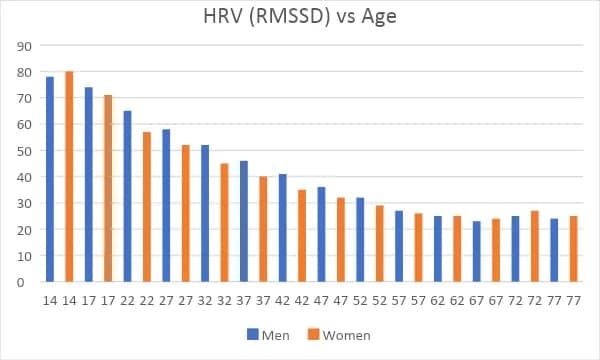
A study in Frontiers in Physiology found that HRV decreases with age, but trained endurance athletes maintain higher HRV compared to sedentary individuals.
👉 https://www.frontiersin.org/articles/10.3389/fphys.2017.00041/full
How to measure HRV accurately
Measuring HRV consistently is key. The most reliable methods include:
Wearables
- Oura Ring
- Whoop
- Garmin devices
Apps with chest straps
- Elite HRV
- HRV4Training
Best practices for accuracy
- Measure at the same time daily (morning is ideal)
- Stay consistent with position (lying down or seated)
- Avoid measuring after caffeine or stress
HRV is not about a single number—it’s about trends over time.
How to assess HRV trends
Instead of asking, “Is my HRV good?”, the better question is:
“Is my HRV normal for me?”
Key patterns to watch:
1. Baseline stability
Your HRV should fluctuate within a consistent range.
2. Sudden drops
A sharp decrease may indicate:
- Poor sleep
- Illness
- Overtraining
- Hormonal disruption
3. Gradual decline
This often signals accumulated fatigue.
4. Upward trends
Indicate improved fitness and recovery.
For HRV for runners over 50, interpreting trends is more valuable than chasing high numbers.
The science behind HRV and endurance performance
HRV reflects the balance between stress and recovery.
In endurance training:
- High HRV → ready for intensity
- Low HRV → prioritize recovery
A study in the Journal of Strength and Conditioning Research showed that HRV-guided training improved performance compared to fixed training plans.
👉 https://journals.lww.com/nsca-jscr
This is especially relevant for marathoners, where recovery determines consistency.
Case study: endurance athlete in her 50s
A 52-year-old female marathon runner tracked HRV over 16 weeks while preparing for a race.
Without HRV awareness:
- Frequent fatigue
- Plateau in performance
- Increased injury risk
After using HRV-guided training:
- Adjusted intensity based on HRV
- Reduced high-intensity sessions during low HRV days
- Prioritized sleep and fueling
Results:
- Improved race time by 6%
- Fewer missed training days
- Better perceived energy
This aligns with findings from HRV-guided training research showing improved adaptation and reduced overtraining.
How to improve HRV naturally
Improving HRV is about supporting your nervous system.
1. Prioritize sleep quality
- Aim for 7–8 hours
- Keep consistent sleep schedule
- Reduce blue light at night
Sleep is the strongest driver of HRV.
2. Fuel properly for training
Under-fueling is one of the biggest mistakes midlife runners make.
Focus on:
- Adequate carbohydrates for endurance
- Protein for recovery
- Healthy fats for hormone support
3. Adjust training intensity
Not every run should be hard.
Use HRV to guide:
- High HRV → speed or tempo
- Low HRV → easy or rest
4. Manage stress (this is huge)
Life stress impacts HRV as much as training.
Effective strategies:
- Breathwork
- Walking
- Time outdoors
- Reducing cognitive overload
5. Strength training
Supports:
- Muscle preservation
- Hormonal balance
- Nervous system resilience
6. Hydration and electrolytes
Dehydration lowers HRV.
Especially important for marathoners.
7. Hormone-aware training
Align training with your cycle (if applicable) or energy fluctuations.
This is where HRV for runners over 50 becomes especially powerful.
Common mistakes runners make with HRV
- Obsessing over daily numbers
- Comparing HRV to others
- Ignoring trends
- Training hard despite low HRV
- Using HRV without adjusting lifestyle
HRV is only useful if you act on it.
Why HRV is a game-changer for marathoners
Marathon training requires:
- High volume
- Consistent recovery
- Smart pacing
HRV helps you:
- Avoid burnout
- Train sustainably
- Peak at the right time
For runners over 50, this can be the difference between finishing strong and breaking down.
Final thoughts
HRV for runners over 50 is not just another metric—it’s a window into your body’s readiness, resilience, and long-term health.
As your body changes, your training approach needs to evolve.
Instead of pushing harder, HRV allows you to train smarter.
And that’s exactly what midlife performance is about.