
Running and aging for women over 40 is not just about staying fit.
It is about influencing biology.
After 40 — and especially through perimenopause and menopause — aging accelerates in measurable physiological ways:
- Muscle mass declines
- Estrogen shifts alter fat storage
- Recovery slows
- Inflammation rises
- Bone density decreases
- VO₂ max naturally declines
But here is the truth most people miss:
Endurance training is one of the strongest predictors of a lower biological age.
Not cosmetic age.
Cellular age.
And the difference matters.
Let’s break down the science — and how beginners and seasoned runners can use running strategically to slow the aging process.
What Aging Actually Means After 40
Starting in our 40s:
Muscle Loss (Sarcopenia)
Adults lose approximately 3–8% of muscle mass per decade after 30, accelerating after 50 (National Institute on Aging).
https://www.nia.nih.gov/health/sarcopenia
For women, declining estrogen worsens this process.
Muscle is not just strength — it is metabolic health.
Decline in Mitochondrial Function
Mitochondria are your cellular power plants.
Aging reduces mitochondrial efficiency, lowering energy production and increasing oxidative stress.
This contributes to fatigue, slower recovery, and metabolic slowdown.
Increased Inflammation
Chronic low-grade inflammation (inflammaging) accelerates:
- Cardiovascular disease
- Insulin resistance
- Cognitive decline
Reduced VO₂ Max
VO₂ max declines about 1% per year after age 30 if untrained.
But trained endurance athletes experience a significantly slower decline (JAMA Network Open).
https://jamanetwork.com/journals/jamanetworkopen/fullarticle/2707428
This is where running and aging for women over 40 becomes powerful.
Chronological Age vs Biological Age
You may be 50 chronologically.
But your biological age — determined by cardiovascular function, muscle integrity, metabolic flexibility, and inflammatory markers — can resemble someone far younger.
Research shows endurance athletes often exhibit:
- Lower resting heart rate
- Improved insulin sensitivity
- Reduced systemic inflammation
- Greater mitochondrial density
(Frontiers in Physiology)
https://www.frontiersin.org/articles/10.3389/fphys.2020.00963/full
Running does not stop time.
It slows deterioration.
How Running Slows the Aging Process
1. Preserves Lean Muscle Mass
While running is primarily aerobic, it still:
- Stimulates lower-body muscle maintenance
- Improves neuromuscular efficiency
- Maintains metabolic rate
When combined with strength training, the effect multiplies.
For women 40+, preserving muscle:
- Prevents metabolic slowdown
- Reduces fall risk
- Supports independence later in life
2. Enhances Mitochondrial Density
Endurance training increases mitochondrial biogenesis — the creation of new mitochondria.
More mitochondria =
- Better fat oxidation
- Higher energy levels
- Reduced oxidative damage
This is directly anti-aging at the cellular level.
3. Reduces Chronic Inflammation
Moderate endurance exercise lowers inflammatory markers such as CRP and IL-6.
Chronic inflammation is linked to:
- Cardiovascular disease
- Diabetes
- Neurodegeneration
Regular running improves immune surveillance and cellular repair mechanisms.
4. Supports Hormonal Regulation
Estrogen declines during perimenopause.
This affects:
- Fat storage
- Mood
- Recovery
- Sleep
Running improves:
- Insulin sensitivity
- Stress resilience
- Endorphin release
- Growth hormone secretion
However, excessive intensity can elevate cortisol, which may accelerate aging if chronic.
The key is balanced training.
5. Protects Brain Function
Running increases:
- Blood flow to the brain
- BDNF (brain-derived neurotrophic factor)
- Neuroplasticity
Higher BDNF levels correlate with improved memory and reduced cognitive decline risk.
(Scientific Reports, Nature)
https://www.nature.com/articles/s41598-018-38194-3
For women over 40, this is critical.
You are not just protecting your legs.
You are protecting your brain.
The Pros of Running After 40
✔ Preserves muscle
✔ Slows VO₂ max decline
✔ Improves metabolic flexibility
✔ Reduces inflammation
✔ Supports mood stability
✔ Maintains bone density
✔ Protects cardiovascular health
The Cons (When Done Incorrectly)
Running is not automatically anti-aging if:
- Recovery is ignored
- Sleep is compromised
- Strength training is absent
- Nutrition is inadequate
- Intensity is excessive
Overtraining elevates cortisol, increases injury risk, and can accelerate muscle breakdown.
Longevity favors consistency over extremism.
Running Strategy for Beginners Over 40
If you are starting at 40+:
- Begin with walk-run intervals
- Focus on conversational pace
- Run 3 days per week initially
- Add strength training twice weekly
- Increase mileage gradually
Build aerobic base first.
Do not chase speed.
Adaptation matters more than intensity.
Running Strategy for Seasoned Midlife Runners
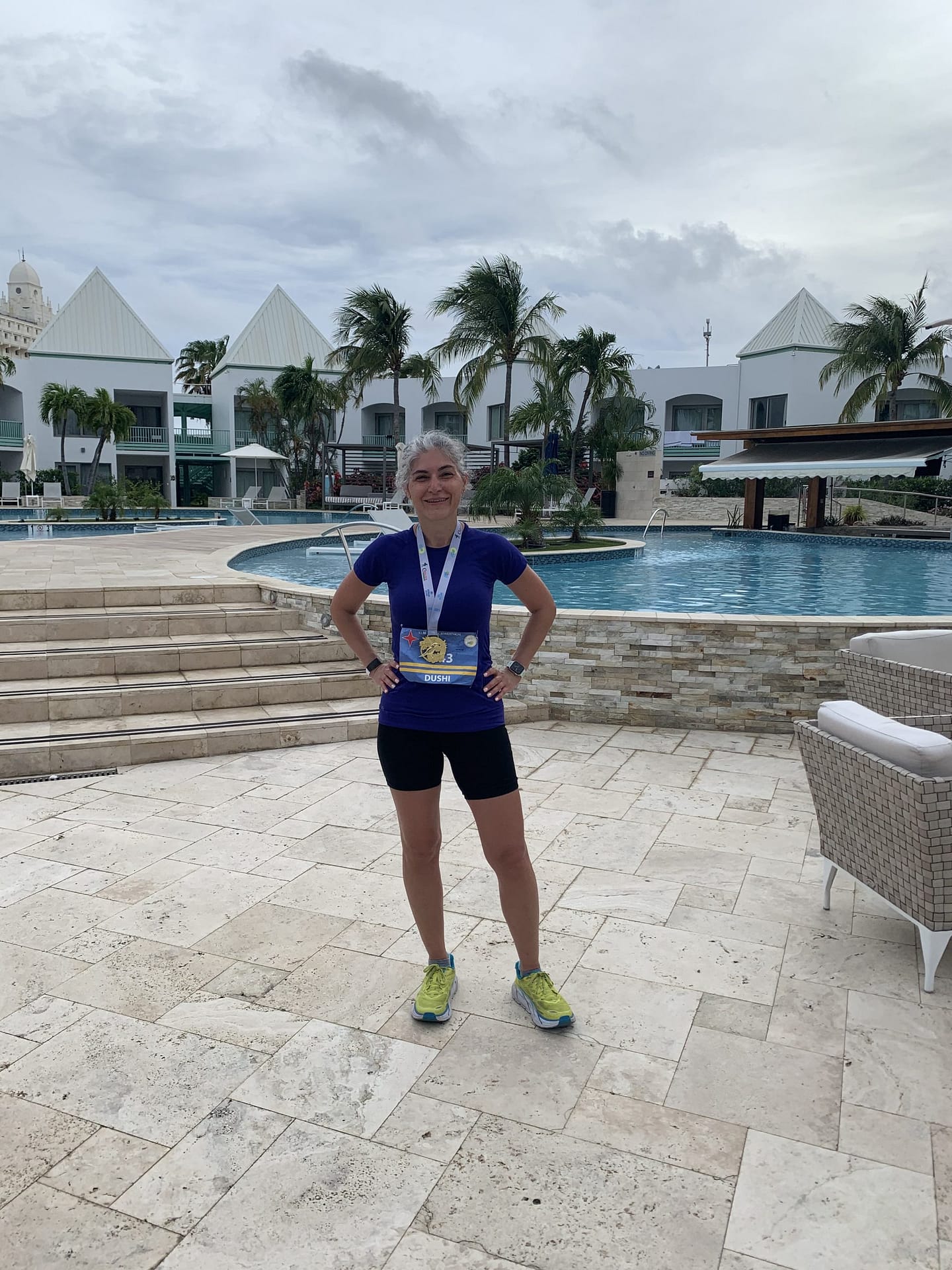
If you are like me — 53 and still racing:
Adjustments become strategic.
- Emphasize Zone 2 training
- Limit high-intensity sessions to 1–2 per week
- Strength train consistently
- Prioritize sleep
- Fuel with adequate protein (1.2–1.6 g/kg)
This maintains performance while minimizing aging acceleration.
Bone Density and Impact Loading
Running provides mechanical stimulus to bones.
Weight-bearing exercise helps maintain bone density, particularly important during menopause.
National Institute on Aging recommends weight-bearing activity to reduce osteoporosis risk.
https://www.nia.nih.gov/health/osteoporosis
However:
Excessive mileage without recovery increases stress fracture risk.
Balanced programming is essential.
Metabolic Health and Fat Distribution
Menopause increases central fat storage.
Running improves:
- Insulin sensitivity
- Fat oxidation
- Glucose regulation
But nutrition matters.
Protein intake must increase with age to preserve muscle mass.
The Psychological Advantage
- Builds resilience
- Enhances self-efficacy
- Reduces anxiety
- Supports emotional regulation
Midlife often brings identity shifts.
Running becomes stability.
Consistency becomes power.
The Balanced Formula for Slowing Aging Through Running
- Run consistently (not excessively)
- Strength train twice weekly
- Sleep 7–9 hours
- Eat adequate protein
- Reduce ultra-processed foods
- Manage stress
- Hydrate properly
Running amplifies healthy habits.
It does not compensate for poor recovery.
Final Thoughts
Running and aging for women over 40 is not about chasing youth.
It is about protecting function.
You may not run faster at 50 than 30.
But you can:
- Maintain cardiovascular strength
- Preserve lean muscle
- Protect cognitive health
- Slow biological decline
For beginners, running builds a foundation.
For seasoned runners, it becomes longevity strategy.
You cannot stop chronological aging.
But you can strongly influence how well your body performs as years pass.
And that is the real race.